
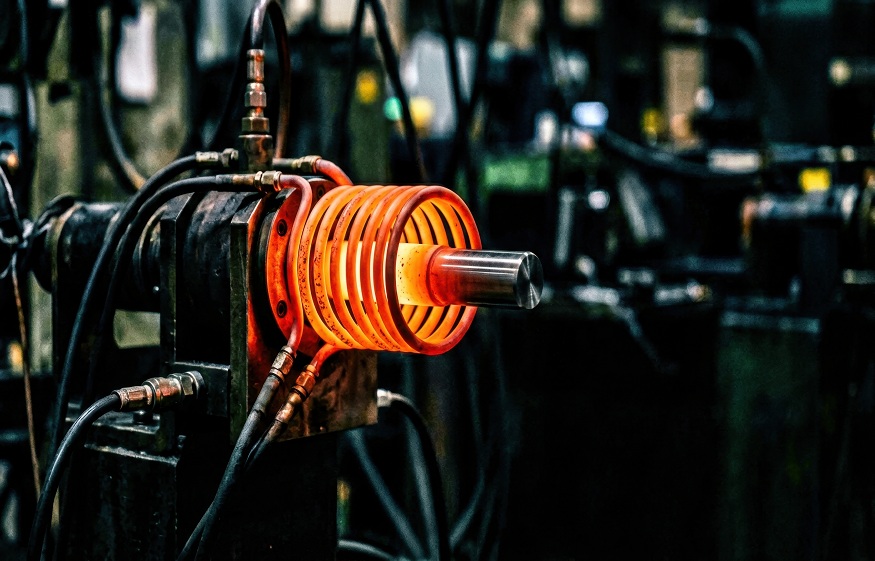
Crank the temperature past 1,000°F, and most engineering materials start making confessions. Metals creep. Polymers char. Fasteners loosen as thermal expansion throws tolerances out the window. But certain components sit in that same punishing environment and barely flinch. What separates them isn’t luck. It’s material selection, and the thermal thinking that happened long before anyone cut metal or laid up fiber.
Heat Doesn’t Just Weaken Things
There’s a tendency to think of heat on a sliding scale. Hotter equals weaker. That misses what’s actually going on. Heat changes how a material behaves internally. Metals undergo grain boundary creep during prolonged exposure, slowly warping under loads they’d shrug off at room temperature. Polymer matrices in conventional composites go soft once they blow past their glass transition point. The fibers might still be perfectly fine, but the resin has quit doing its job and the laminate falls apart structurally.
Then there’s thermal cycling. This is its own kind of torture. A part that swings from 800°F to ambient fifty times a week isn’t living the same life as one that just parks at 800°F continuously. Every expansion and contraction round plants new micro-cracks. The cracks expand steadily over time.
Read More: Why Some of the Strongest Products Start Out Surprisingly Light
Metals Can Only Take So Much
Nickel superalloys have earned their place in jet engine hot sections. That’s not disputed. However, their weight is considerable. Moreover, extensive metallurgical improvements over many years have brought them near their maximum potential.
Higher turbine inlet temperatures improve fuel efficiency through hotter combustion. Engine designers need temperatures beyond superalloy limits without complex cooling passages. And those cooling channels? They add weight, introduce new ways for things to break, and make manufacturing significantly harder. Eventually, the effort put into cooling exceeds the effort put into the component itself.
Ceramics Fill a Gap Metals Can’t Reach
Ceramics can tolerate heat that would melt a superalloy. Silicon carbide does not deform even at temperatures over 2,000°F. Alumina and zirconia each boast impressive thermal ranges. However, ceramics were traditionally criticized for being brittle. A monolithic ceramic part can fracture suddenly and with no prior indication of bending or yielding.
Incorporating continuous fibers into a ceramic matrix significantly altered the situation. Fibers span across developing cracks, maintaining structural integrity. Even though the crack remains, the component continues to operate. That kind of graceful damage tolerance was never possible with plain ceramics.
Interest in ceramic matrix composites for high-temperature industrial applications has grown steadily as manufacturing methods have matured past the experimental stage. Axiom Materials has addressed one of the key bottlenecks in that progression: developing precursor materials and prepreg formats that give production teams a workable process from layup through final cure, rather than leaving them to figure out the processing science on their own.
Read More: Utah Asphalt Contractor Expertise in Crack Sealing and Repairs
Material Alone Doesn’t Guarantee Anything
A material’s extreme heat resistance is rendered useless if the design doesn’t consider thermal conditions. Differences in temperature cause internal stresses. Sharp corners concentrate them. And bolting a CMC part to a metal substructure without planning for expansion mismatch is basically setting a timer on a crack.
Good high-temperature design means thinking about the whole assembly. Where does heat flow? How does each piece expand relative to its neighbor? Where is strain being absorbed versus resisted? Miss any of those questions and the material’s raw capability won’t save you.
Conclusion
The materials to survive extreme heat environments exist right now. They’ve been flight-tested and field proven. Whether they actually perform in a given application depends entirely on the engineering decisions surrounding them. The material opens the door. The design has to walk through it.