

Introduction
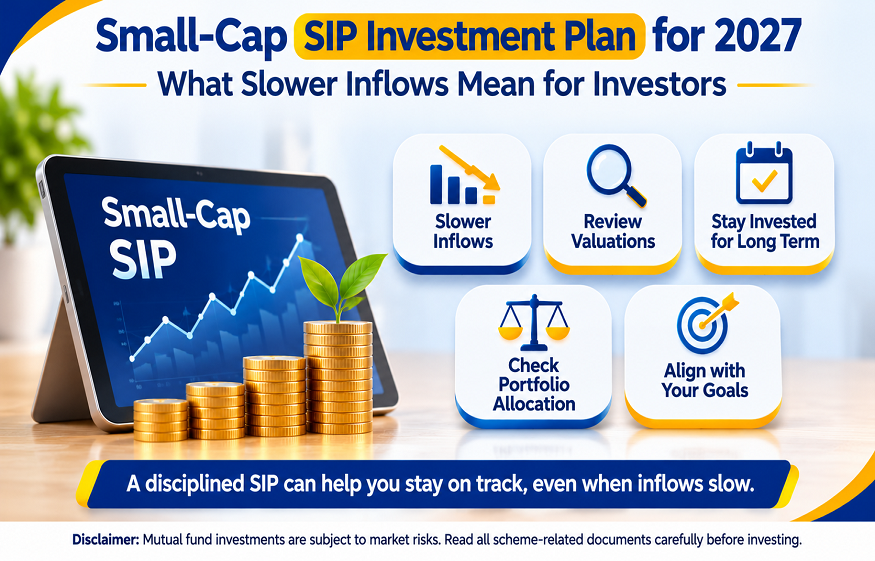
Should investors rethink their small-cap SIP investment strategy for 2027 if the inflows start to taper off? Not so fast. The slow inflows could be a sign of a shift in investor sentiment, greater caution on valuations or a move into other types of mutual funds. But that doesn’t mean they portend poor future returns or that a market correction is imminent. For long-term investors, the more relevant questions are those related to their exposure to the portfolio, investment horizon, fund liquidity and ability to endure volatility. Investors can use a systematic SIP investment plan to average their purchases over market cycles but they can’t avoid losses. Before you start, continue or increase a small-cap SIP in 2027, it is important to understand what changing inflows reveal and what they do not.
1. Understanding Slower Inflows into Small-Cap Mutual Funds
Small-cap mutual funds mainly invest in smaller listed companies that may have considerable business growth potential but are typically more volatile in price than mature large-cap businesses. Small-cap companies are those ranked 251st and beyond in terms of full market capitalization, according to the categorization framework of mutual funds by Sebi. Small-cap mutual fund schemes are mandated to invest a minimum of 65% of their assets in equity and equity-related instruments of small-cap companies.
Investors talk about slowing inflows. We have to distinguish three situations:
- Lower gross inflows: New money coming into a category has decreased.
- Net inflows have narrowed: The gap between purchases and redemptions has narrowed.
- Net outflows: Redemptions exceed new investments in a given period.
The outcomes of these situations are different. A slowdown in net inflows doesn’t necessarily mean money is coming out. The category could still see investment, but at a slower pace. It is just as important to see if the slowdown is temporary or persistent over a number of months. Investors should look at the updated AMFI monthly data for 2027, rather than assume that a decline in one period is a lasting trend.
3. Why Slower Inflows Matter for a SIP Investment Plan
Mutual fund inflows change the amount of fresh capital fund managers have to deploy. This is especially true in small-cap investing, as smaller companies generally have lower trading volume and less market depth. Fund managers might find it difficult to invest large sums during periods of big inflow without moving stock prices. When inflows moderate, managers may have more room to deploy new capital. But a big spike in redemptions can create all kinds of problems.
Potential implications for investors
Valuation discipline Slower inflows could ease some of the demand-driven pressure on small-cap valuations, but earnings, market sentiment and other institutional investors still matter.
Portfolio liquidity: Fund managers face the challenge of balancing investment opportunities with the need to meet redemption requests.
Investment opportunities: Market corrections can present opportunities to buy fundamentally sound companies at more appealing valuations.
Short-term volatility: Small-cap stocks can be subject to sharp price swings when the market’s liquidity dries up.
The key difference is that fund flows tell you about investor behavior, not a reliable indicator of future returns. Hence, a good SIP investment plan should not be based on the monthly subscription trends but should be aligned to one’s long-term financial objectives.
2. Is 2027 a Suitable Time to Start a SIP in Small Cap Funds?
Investors should begin by evaluating their financial circumstances rather than trying to identify the perfect market entry point, when considering a SIP in small cap funds. Small-cap equity investments are best for investors with long investment horizons, diversified portfolios, and enough financial flexibility to withstand large interim losses. It may give you more time to ride out the market cycles, but it does not guaranty a positive return. Seven to ten years or more may be a horizon.
Here are some questions to ask yourself before investing:
- Can the investment be left untouched for a long period of market decline?
- Do you already have an adequate emergency fund?
- Are near-term financial objectives funded by more appropriate investments?
- Is the portfolio already meaningfully exposed to smaller companies?
- Can one continue SIP contributions even when returns are not good?
Investors with large financial commitments such as buying a home or funding education should steer clear of a concentrated small-cap allocation. Investors should also be aware that while a longer investment horizon enhances flexibility, it does not eliminate business, valuation or liquidity risks.
4. How SIP Mutual Fund Investing Works During Market Volatility
A SIP mutual fund investment involves contributing a predetermined amount at regular intervals, typically monthly.Rather than investing the entire amount at one market level, investors purchase mutual fund units at different net asset values (NAVs).When NAVs decline, the same contribution purchases more units. When NAVs rise, fewer units are purchased.This mechanism is known as rupee-cost averaging.
Illustrative SIP calculation
Consider an investor contributing ₹5,000 monthly to a small-cap mutual fund over six months.
| Month | Illustrative NAV (₹) | SIP Amount (₹) | Units Purchased |
| January | 50 | 5,000 | 100.00 |
| February | 45 | 5,000 | 111.11 |
| March | 40 | 5,000 | 125.00 |
| April | 42 | 5,000 | 119.05 |
| May | 48 | 5,000 | 104.17 |
| June | 52 | 5,000 | 96.15 |
| Total | — | 30,000 | 655.48 |
Illustrative outcome:
- Total investment: ₹30,000
- Total units accumulated: Approximately 655.48
- Average acquisition cost: Approximately ₹45.77 per unit
- Portfolio value at ₹52 NAV: Approximately ₹34,085
The calculation demonstrates the effect on average cost of acquisition of investing over fluctuating NAVs. However, if the NAV subsequently falls then the value of the investment may be less than your total contributions.
Important: These are hypothetical NAVs for illustrative purposes only and are not historical returns or projections. Illustration does not include applicable charges and taxes. Cost rupee averaging does not ensure profits and does not protect investors from losses in the markets.
5. How to Evaluate the Best Small Cap Mutual Funds for 2027
Recent returns alone may lead to bad investment decisions when selecting the best small cap mutual funds. A fund that did well in one market cycle may not do well when market conditions change. The following factors are included in a better evaluation.
Investment strategy and portfolio quality
Look at the fund’s investment philosophy, portfolio diversification and the amount invested in individual companies or sectors. A concentrated portfolio can be more volatile if some holdings don’t perform well.
Risk-adjusted performance
Review performance across different market environments rather than relying on one-year returns.
Useful measures include:
- Rolling returns across comparable periods
- Standard deviation and downside volatility
- Maximum drawdown
- Performance relative to the appropriate benchmark
- Consistency of investment strategy
Liquidity management
Small-cap funds may hold relatively larger amounts of relatively illiquid securities. Investors should look at what the fund says about portfolio liquidity, as well as fund size and how the manager treats subscriptions and redemptions.
Expense ratio and exit load
Fund costs eat into the returns that investors ultimately receive. Compare direct and regular plans, understand the exit loads that are applicable and see whether the fund’s strategy justifies its costs.
Fund management consistency
Changes in fund managers, investment process or portfolio positioning may impact future performance. There is no single metric that can confidently identify the best fund. The aim should be to choose a scheme that is appropriate to the investor’s risk appetite and financial objectives.
- Should Investors Continue, Pause or Increase Their Small-Cap SIPs?
Slower inflows alone are insufficient grounds for changing an existing investment plan.
The appropriate decision depends on personal circumstances.
| Investor Situation | Possible Approach | Key Consideration |
| Long investment horizon and suitable allocation | Continue SIP | Avoid reacting to short-term sentiment |
| Small-cap exposure exceeds intended allocation | Rebalance gradually | Control portfolio concentration |
| Income uncertainty or inadequate emergency savings | Review or reduce SIP | Prioritise financial stability |
| Higher disposable income and appropriate risk capacity | Consider a measured SIP increase | Avoid excessive exposure |
| Financial goal approaching within a few years | Reduce dependence on small-cap equity | Protect goal-related capital |
The temptation to increase SIP contributions after a correction might be felt. Attractive valuations are not automatic with lower prices. Similarly, investors can stop buying units at lower NAVs by halting their SIPs during a market downturn. Neither should be compulsory. The decision should be made after considering financial objectives, asset allocation and risk-bearing capacity.
- Building a Disciplined Small-Cap SIP Investment Plan for 2027
A practical investment strategy should remain flexible enough to accommodate changing financial circumstances without depending on market predictions.
A five-step investor checklist
- Define the financial goal: Identify the purpose of the investment and the expected withdrawal timeline.
- Determine asset allocation: Decide how much overall equity exposure, including small-cap exposure, is appropriate.
- Select a suitable fund: Evaluate portfolio quality, risk measures, costs and investment philosophy.
- Automate contributions: Choose a sustainable monthly amount rather than an ambitious contribution that may become difficult to maintain.
- Review periodically: Assess allocation, fund performance and financial circumstances at least annually or after a material change.
Investors may also consider whether a diversified equity fund offers sufficient small-cap exposure without requiring a separate concentrated allocation.A SIP should support a financial plan, not become a commitment to one market segment regardless of changing circumstances.
Conclusion: Focus on Investment Discipline, Not Fund Flows
A slow inflow into small-cap mutual funds can be a good indicator of investor sentiment, liquidity conditions and valuation concerns. However, they cannot independently determine whether 2027 will be good or bad for small-cap investing. For investors with a suitable risk profile and long-term objectives, it may be wiser to continue investing in a disciplined SIP plan than to try and time the market’s ups and downs. Diversification should remain, portfolio exposure should be monitored and amounts invested should remain affordable through tough market conditions. At the end of the day, successful investing is not so much about timing the inflows each month but more about making investment decisions that are aligned with financial objectives, risk capacity and time horizon.
Frequently Asked Questions (FAQs)
Will small cap mutual fund SIP investment plan be good in 2027?
A SIP could be a good fit for investors with long investment horizons, adequate financial reserves and the ability to tolerate significant volatility. Whether it is right for you depends on your own circumstances not the year of the calendar.
- Should I stop SIP in small cap funds if there are inflows?
Not always. Slower inflows does not automatically mean poor future returns. Please review your financial objectives, portfolio allocation and fund fundamentals before you change your contributions.
- What amount should beginners invest in small-cap mutual funds via SIPs?
“There is no right amount. To start with, beginners should set up an emergency fund and decide on an appropriate equity allocation. Small cap exposure can be a small part of a diversified portfolio where appropriate.
- How to select the best small cap mutual funds for long term investment?
Compare investment strategy, rolling returns, volatility, portfolio diversification, liquidity, expense ratios and benchmark relative returns. Don’t select funds solely on past performance rankings.
- Does SIP ensure positive returns when small-cap markets bounce back?
No. SIPs spread investments across different market levels, but they do not guaranty returns. The outcome depends on underlying securities, valuations, market conditions, costs and the timing of withdrawals.
Disclaimer: Mutual fund investments are subject to market risks. Read all scheme-related documents carefully before investing. The examples and discussions in this article are for educational purposes only and do not constitute personalised investment advice.