

Most salaried employees treat their employer-provided health coverage as a box already ticked. It feels like one less thing to worry about until a medical emergency reveals just how thin that safety net actually is. The math behind group health insurance tells a story most employees never bother to run.
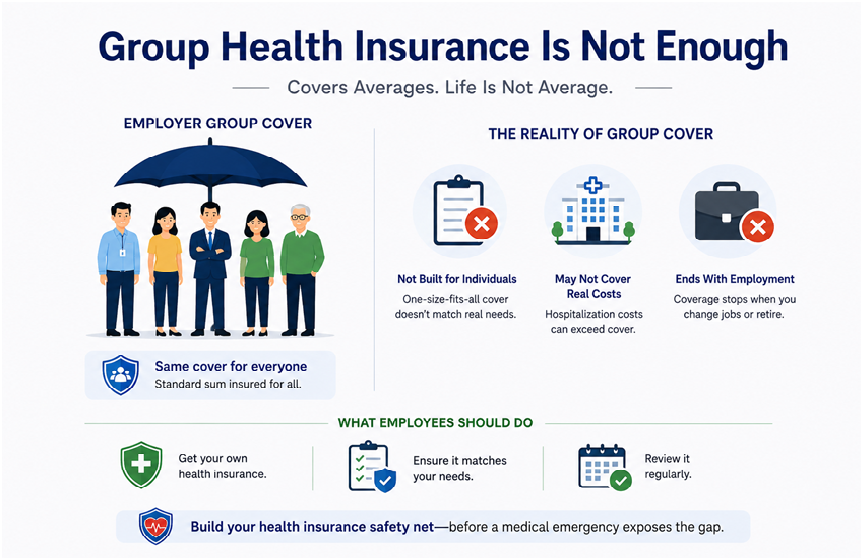
Group cover is designed for averages, not individuals. Employers typically negotiate a standard sum insured, often ₹2-5 lakh, applied uniformly across the workforce, regardless of an employee’s age, family size, or medical history. A 25-year-old single employee and a 45-year-old employee supporting parents and children receive the same cover amount, even though their actual risk and family medical costs differ enormously.
The sum insured rarely matches real hospitalization costs. A single cardiac procedure, cancer treatment cycle, or ICU stay in a metro city can easily cross ₹8-15 lakh. Against a ₹3-5 lakh group policy, that leaves a substantial gap the employee must fund out of pocket precisely at a moment when the illness itself may already disrupt income.
Read More: What Online Shopping Can Teach Us About Rent Collection
Coverage disappears the moment employment ends. Group health insurance is tied to your job, not to you. Resign, get laid off, or retire, and the coverage typically ends immediately or within a short transition window. If you’re diagnosed with a condition while employed and then change jobs, the new employer’s policy or an individual policy you scramble to buy may treat that condition as pre-existing, triggering waiting periods of two to four years before it’s covered again.
Family coverage is often minimal or absent. Many group policies cover only the employee, with spouse, children, or parents added at extra cost or excluded entirely. Employees frequently discover this gap only when a family member needs hospitalization, not when the policy was issued.
No portability control. You don’t choose your insurer, network hospitals, or policy terms your employer does, and these can change year to year based on renewal negotiations. A hospital that was in-network last year may not be this year, disrupting continuity of care for chronic conditions.
The math that proves the gap: Consider an employee with ₹5 lakh group cover, no personal policy, supporting a spouse and two children. A single serious hospitalization for any family member, say a ₹9 lakh cardiac surgery, leaves a ₹4 lakh shortfall funded through savings, credit cards, or loans, on top of income loss during recovery. Multiply this risk across a 30-year working life, and group covers alone statistically fail to protect against at least one major gap event for most families.
Read More: How Entrepreneurs Source Inventory from Unclaimed Storage Units
What employees should actually do?
- Treat group health insurance as a supplementary layer, not primary protection.
- Buy an individual or family floater policy sized to your actual dependents and your city’s treatment costs, independent of your job.
- Ensure your personal policy has no overlap-dependent waiting periods that assume continuous group coverage.
- Review your combined cover (group + personal) annually, especially after salary changes, marriage, or having children.
Relying solely on what your employer provides is a common blind spot one that only becomes visible when a real medical bill exceeds what the group policy pays out. Building a personal health insurance layer alongside your workplace cover is one of the simplest ways to close this gap before it becomes a crisis.
If you’re unsure whether your current group cover leaves you exposed, you can explore individual and family health insurance options suited to your needs at airpay money, which connects you with trusted insurers to compare plans against your actual risk.